A much older story than one might think
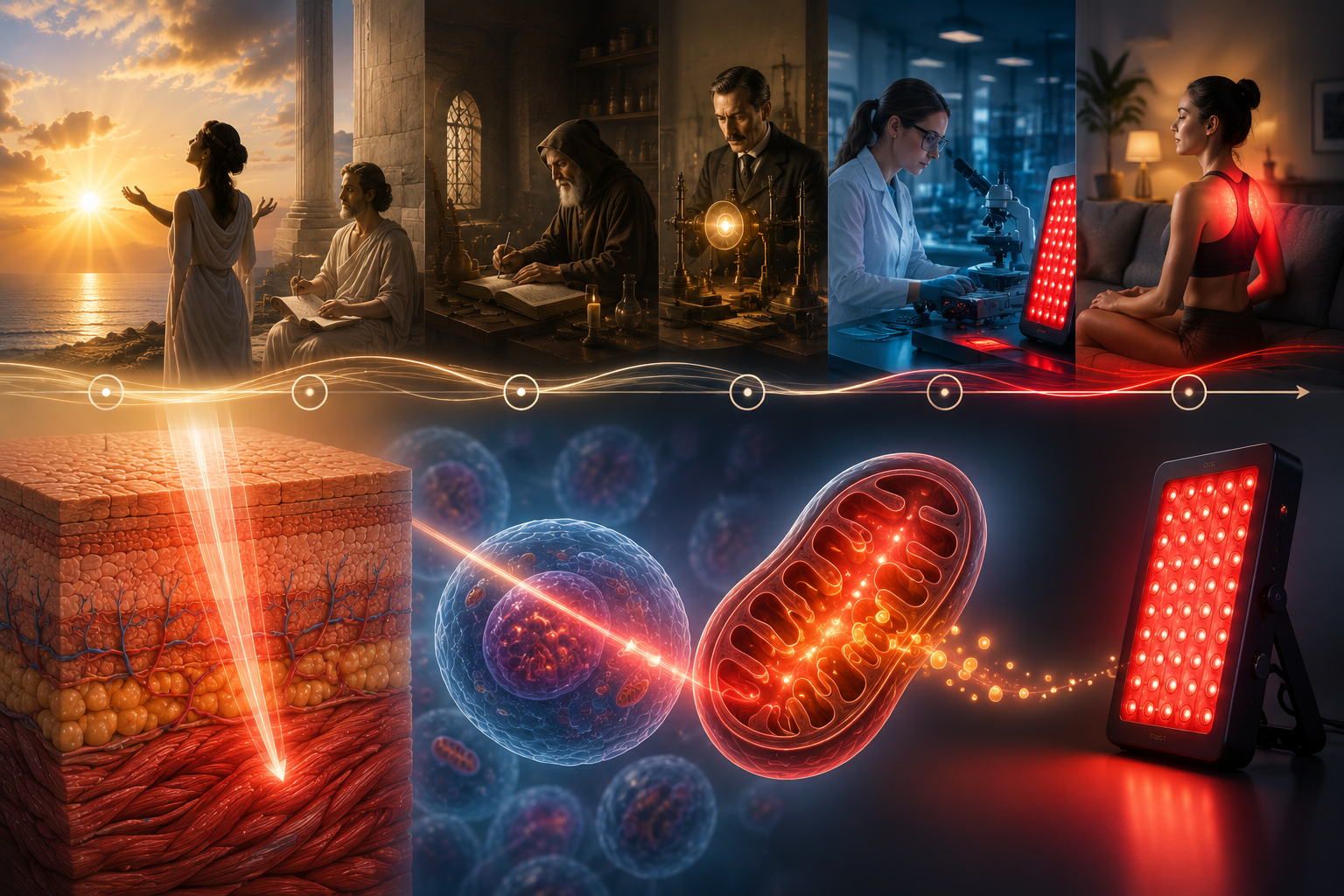
Light therapy may seem like a recent technology. Yet, the therapeutic use of light dates back thousands of years.
Long before the existence of modern devices, various civilizations were already interested in exposure to sunlight and its influence on the body.
But at that time, light was used long before there was a true understanding of how it interacted with living organisms.
From observation to science
With the evolution of physics, medicine, and biology, our understanding of light has transformed.
We now know that light carries energy in the form of photons, the quanta of light, and that different wavelengths interact differently with biological tissues.
Through research, scientists began to better understand how this light energy could be absorbed by certain molecules and influence cellular activity.
The study of these interactions gradually contributed to the development of what we now call photobiomodulation.
A technology long reserved for professionals
For a long time, technologies capable of precisely delivering certain wavelengths were primarily associated with specialized equipment used in professional and research settings.
Devices were less accessible, often more complex, and much more expensive than they are today.
Then technology evolved.
The development of LEDs, improvements in the control of wavelengths, power, and exposure parameters have made it possible to design more compact, easier-to-use, and non-invasive devices.
This evolution is now making photobiomodulation much more accessible, including with devices designed for home use.
Thousands of years of interest. Decades of research. A technology that continues to evolve.
What began with the observation of natural light has become a field studied at the scale of photons, tissues, and cells.
And research continues.
At Goldride Light Therapy, we believe that this part is essential: technology alone is not enough. We must also understand the science behind it.
Wavelength, power, dose, exposure duration, and method of use are all parameters that can influence how light energy is delivered to tissues.
Because a better understanding of light also means a better understanding of how to use the technology.
What is light therapy?
What if this modern technology is based on an interaction our body has always known?
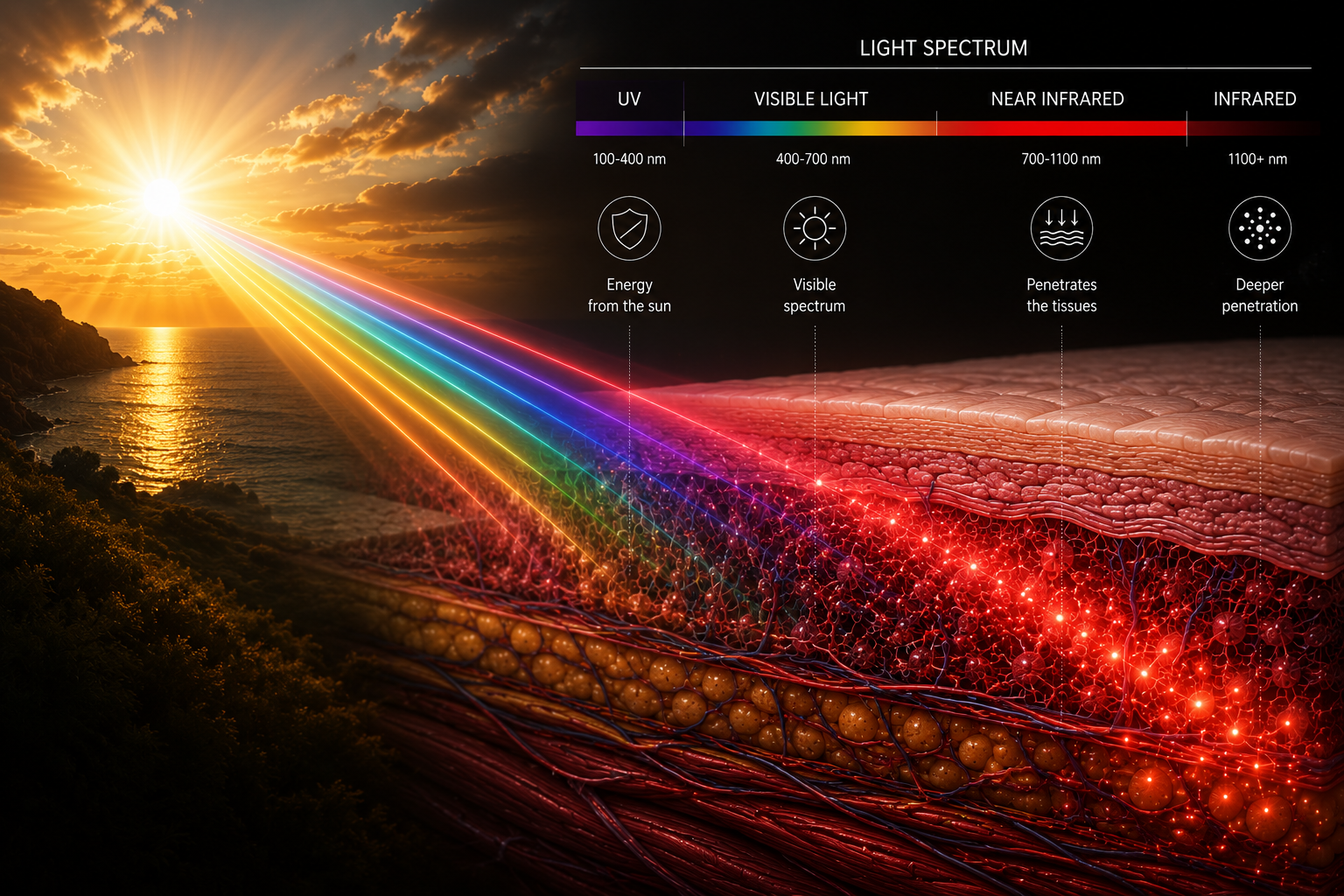
Since the beginning of human existence, our bodies have evolved in the presence of sunlight. This light is not made up of a single color: it contains a wide spectrum of wavelengths, including visible light and infrared.
When light reaches our body, it doesn't just illuminate it. It can also interact with our tissues and trigger various biological responses. The best-known example is probably the production of vitamin D under the effect of UVB rays, but the interactions between light and living organisms go far beyond this mechanism.
This is where photobiomodulation becomes particularly interesting.
From sunlight to controlled light
Photobiomodulation, also known as light therapy, does not seek to reproduce the sun as a whole. Instead, it relies on our scientific understanding of how certain wavelengths of light interact with biological tissues.
The difference is important.
The sun simultaneously exposes us to a very broad spectrum of light. A photobiomodulation device, on the other hand, allows us to select certain wavelengths and control their power, exposure time, and the amount of energy delivered.
In other words, we have moved from a natural and very complex exposure to light to a technology that allows us to study and use some of these interactions much more precisely.
Our body doesn't just see light. It interacts with it.
Light carries energy in the form of photons. When they encounter tissues, some are reflected, others scattered, and some can be absorbed by molecules present in the body.
It is this interaction between light, energy, and biology that is at the heart of photobiomodulation.
And this is probably what is most surprising:
The technology is modern.
The interaction between light and living organisms is not.
How does light therapy work?
Light therapy, also known as photobiomodulation, uses specific wavelengths to deliver light energy to tissues.
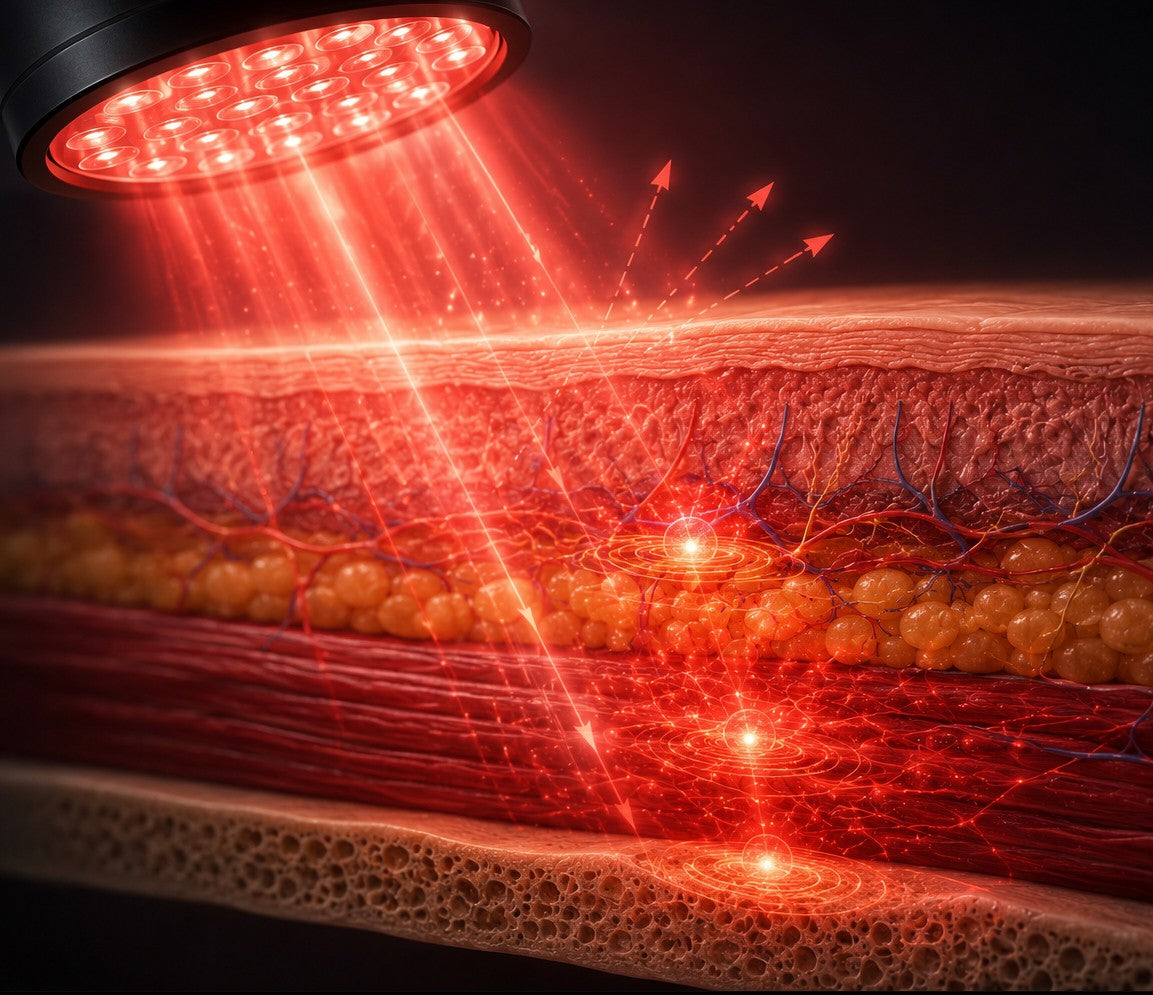
When light encounters the body, it doesn't follow a single path. Some is reflected, some is scattered, while some penetrates the tissues.
What happens next depends largely on the wavelength used.
Each wavelength behaves differently
Light is composed of different wavelengths, and each has characteristics that influence its interaction with tissues.
In photobiomodulation, certain wavelengths in the red and near-infrared range are mainly used, typically in a range of approximately 600 to 1100 nm.
Why this choice?
Because the wavelength influences, among other things, the absorption, scattering, and penetration depth of light into tissues.
It therefore helps determine where light energy can be delivered and how it interacts with the body.
At Goldride, we specifically use 660 nm and 850 nm, two wavelengths commonly used in photobiomodulation.
[ Learn more about wavelengths ]
But what happens to this light once it's in the tissues?
This is where the phenomenon becomes particularly interesting.
Light carries energy in the form of photons. When they penetrate tissues, some of these photons can be absorbed by molecules capable of interacting with light.
This absorption can then influence various biological mechanisms within cells.
Among the structures involved are the mitochondria, often described as the powerhouses of our cells.
These structures play an essential role in the production of ATP (adenosine triphosphate), a molecule that cells use as an energy source to perform their many functions.
The interaction with light can influence certain mitochondrial mechanisms and contribute to processes related to ATP production.
Light does not directly give energy to cells like a battery being recharged. Instead, it triggers biological interactions capable of influencing their function.
A complex principle, simply summarized
Behind photobiomodulation are numerous biological mechanisms, but its general principle can be summarized in three steps:
Light penetrates.
Energy is absorbed.
Cells respond.
And it is this interaction between light, energy, and biology that is at the heart of photobiomodulation.
Power, another part of the equation
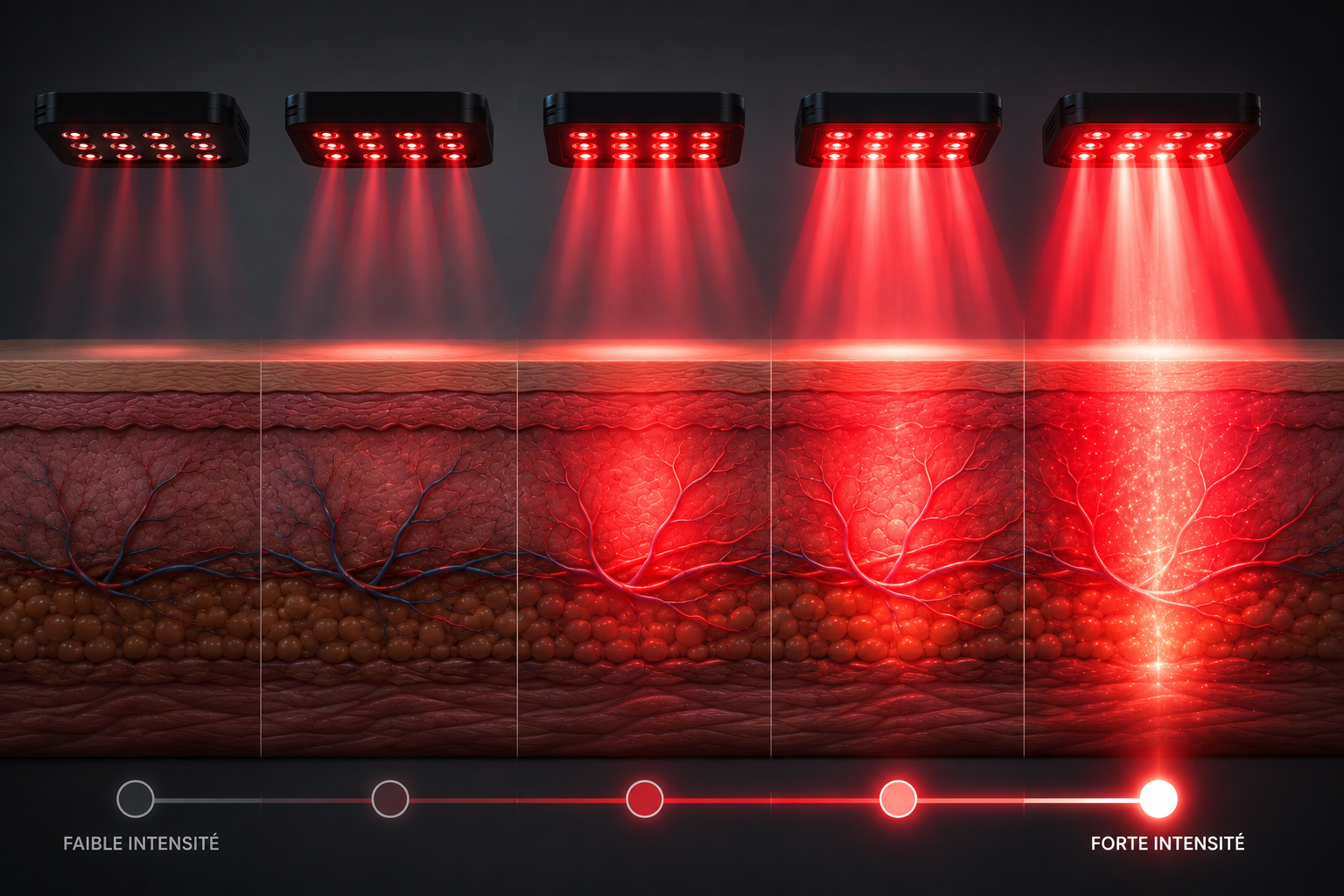
Wavelength influences how light interacts with tissues, but it is only one part of the equation. Light power, exposure time, and distance also influence the amount of energy actually delivered.
In photobiomodulation, the intensity of light received by a surface, called irradiance, is generally expressed in mW/cm² (milliwatts per square centimeter).
Power and time are directly related. The longer an area is exposed to a certain intensity, the greater the total amount of energy delivered.
This amount of energy, called dose or fluence, is generally expressed in J/cm² (joules per square centimeter).
Power × Time = Energy Dose
Distance is also part of the equation
As light leaves the source, it propagates and disperses. The intensity that reaches the targeted area can therefore vary depending on the distance between the light source and the tissues.
This is why a value expressed in mW/cm² is much more informative when you know at what distance it was measured.
Power, exposure time, and distance must therefore be considered together to understand the amount of light energy actually delivered to the targeted area.
Power is also a matter of time
Appropriate power does not simply mean "more power." The goal is to deliver an appropriate energy dose within a suitable exposure time.
To achieve the same energy dose, a lower intensity will generally require a longer exposure time, while a higher intensity mathematically allows this same dose to be achieved more quickly, when appropriate for use.
This is why more powerful does not automatically mean better. It is the balance between power, time, and dose that matters.
And in regular use, this difference becomes very concrete.
Time also has value.
A few extra minutes may seem minimal during a single session. But repeated regularly, they can represent hours over weeks and months.
Understanding power therefore means understanding not only how much energy is delivered, but also how much time is needed to deliver the desired dose.
It's the whole equation that matters
In photobiomodulation, wavelength alone is therefore not enough.
The right wavelength.
The appropriate power.
The correct distance.
The appropriate exposure time.
The desired energy dose.
All these parameters work together to determine how and how much light energy is delivered to the tissues.
Power is not about seeking the highest number, but about delivering the right amount of energy, in the right way, and in an appropriate amount of time.
Quality is also found in what the eye cannot see
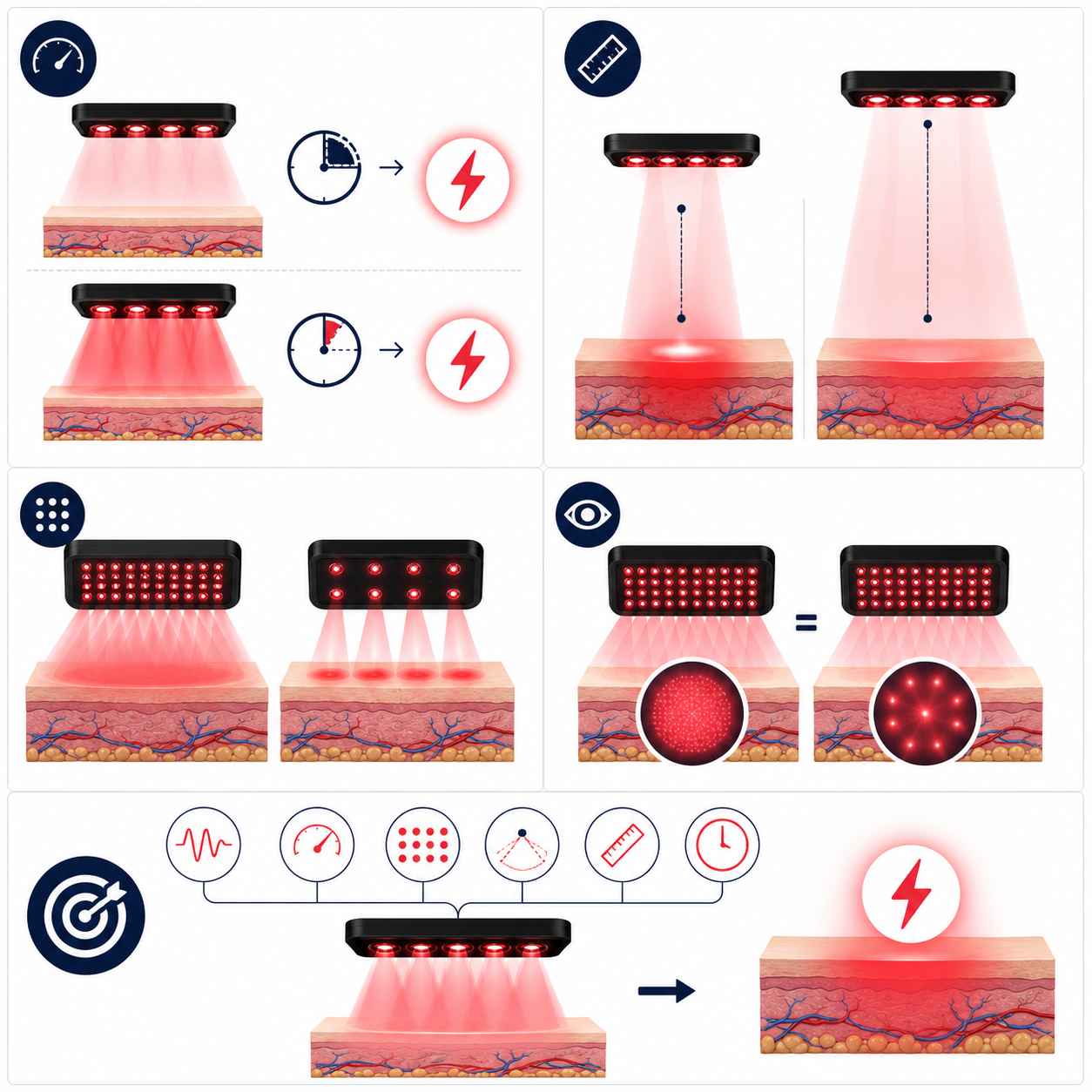
At first glance, two photobiomodulation devices may seem very similar. Same dimensions, same light, sometimes even a comparable number of LEDs.
However, behind this appearance can lie very different designs.
The performance of a device does not depend on a single visible characteristic. It relies on several technical parameters that determine how light is produced, distributed, and delivered.
Let's look beyond the number of LEDs
The number of LEDs is easy to see and compare, but it alone does not indicate the power or quality of a device.
Each LED has its own characteristics. Their power, wavelength, and diffusion angle can vary, as can how they are integrated into the device.
This is why 80 LEDs are not automatically more powerful than 70, for example. To understand what the device actually delivers, you need to look at what's behind that number.
Their arrangement also changes how light is distributed
LED spacing is a good example.
On one device, they may be spaced approximately ¾ inch (1.9 cm) apart, while on another, the spacing can reach 2 inches (5.1 cm) or more.
This changes how the different light beams meet and spread across the targeted surface.
But again, closer does not automatically mean better. Closely spaced LEDs may have a different power than more spaced-out LEDs.
The goal is rather to achieve an adapted, uniform, and controlled light distribution.
So, what determines quality?
This is where you need to look at the device as a complete system rather than a simple collection of LEDs.
Wavelength precision, actual delivered power, LED characteristics, their number and arrangement, their diffusion angle, light uniformity, and performance consistency all contribute to the overall operation.
Added to this is manufacturing quality: electronic components, materials, assembly, and product durability also play a role in its reliability over time.
What truly matters is behind the light
A photobiomodulation device should therefore not be evaluated solely by what can be seen or counted.
Two products that look similar can be constructed very differently and have different light characteristics.
Quality is not based on a single number. It is based on mastery of the whole: precise light, adapted power, uniform distribution, reliable components, and a coherent design.
This allows us to look beyond appearance and better understand the technology that truly lies behind the light.